Have you ever had someone ask, “How are you feeling?” and found yourself saying, “I don’t know,” “I’m fine,” or “I’m just stressed”? Many people are able to recognize that something feels off, but identifying the specific emotion underneath that experience can feel much harder. Maybe you notice that you are more irritable than usual, overwhelmed by small things, or disconnected from the people around you, but you cannot quite figure out why. The truth is, many of us were never taught how to recognize, name, and understand our emotions.
At Heartland Therapy Connection, we often talk with clients about the importance of emotional awareness because emotions are not something we need to eliminate or avoid. They are information. They tell us something about our experiences, our needs, our relationships, and what is happening internally. Learning how to identify emotions can help us respond differently to stress, communicate more effectively, and better understand ourselves. One helpful tool for developing this skill is the feelings wheel.
What Is the Feelings Wheel and Why Is It Helpful?
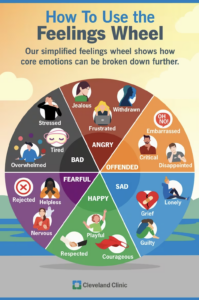
Source: Cleveland Clinic
The feelings wheel is a tool designed to help people expand their emotional vocabulary. Many of us grow up knowing only a handful of emotional words: happy, sad, angry, and anxious. While those words are accurate, they often do not tell the full story of what we are experiencing.
For example, saying “I’m angry” could mean many different things. Maybe you are frustrated because you feel unheard. Maybe you are hurt because someone disappointed you. Maybe you are overwhelmed because you have too many responsibilities and feel like you cannot keep up. The emotion of anger may be present, but the deeper feeling underneath it can provide much more information.
The feelings wheel helps us move from broad emotional categories into more specific emotions. Instead of simply identifying that you are “mad,” you might discover that you are actually feeling:
- Disappointed because something did not happen the way you hoped
- Rejected because you feel unseen or unimportant
- Overwhelmed because your responsibilities feel too heavy
- Afraid because you are uncertain about what comes next
- Lonely because you feel disconnected from others
That difference matters because the way we respond depends on what we are actually feeling. When we can identify the emotion underneath the reaction, we have more options for what to do next.
Your Body Often Knows Before Your Mind Does
One of the most interesting parts of emotional awareness is that our bodies often recognize emotions before we consciously understand them. Have you ever noticed your shoulders tightening during a stressful conversation? Or your stomach dropping before receiving difficult news? These physical reactions are not random. They are your nervous system responding to what is happening around you.
Our emotions are connected to our physical experiences. Anxiety may show up as a racing heart, tight muscles, restlessness, or difficulty breathing. Sadness may feel heavy in your chest or leave you feeling drained of energy. Anger may create heat in your body, tension in your jaw, or a desire to react quickly.
This connection between the body and emotions is one reason many therapeutic approaches focus on noticing physical sensations. In therapies like Dialectical Behavior Therapy (DBT), clients learn skills that help them observe their emotions without immediately reacting to them. Instead of judging an emotion or trying to push it away, the goal becomes noticing what is happening and understanding the message behind it.
A helpful question to ask yourself is not only, “What am I feeling?” but also, “Where do I feel this in my body?”
You might notice:
- Tightness in your chest when you feel anxious
- A heavy feeling when you feel sad or discouraged
- Tension in your shoulders when you feel overwhelmed
- Restlessness when you feel uncomfortable or uncertain
Learning to pay attention to these physical signals can help your mind begin sorting through what is happening emotionally.
Why Is It So Hard to Identify Our Feelings?
For many people, emotional awareness is not something that came naturally because it was not something they were taught. Children develop emotional vocabulary through relationships with caregivers who help them make sense of their experiences. When a child is upset and an adult says, “You seem disappointed,” or “That must have felt scary,” the child begins learning how to connect their internal experience with emotional language.
However, not everyone grows up with those conversations.
Some people grow up in families where emotions were rarely discussed. Others may have learned that certain emotions were unacceptable. Maybe anger was the only emotion that received attention, or sadness was dismissed with phrases like “you’re okay” or “don’t worry about it.” Over time, a person may learn to ignore or disconnect from their emotions simply because they were never given the tools to understand them.
This can also be difficult for people who have experienced trauma or chronic stress. When someone has spent a lot of time in survival mode, the brain often prioritizes getting through the moment rather than reflecting on emotional experiences. Understanding your feelings requires slowing down, noticing yourself, and feeling safe enough to be curious about what is happening internally.
Men, in particular, may experience challenges with emotional vocabulary because many boys are still raised with messages that discourage vulnerability. While this is changing, many men have grown up hearing that emotions like sadness, fear, or hurt should be hidden or pushed aside. This does not mean men do not experience these emotions. It simply means they may have had fewer opportunities to practice identifying and expressing them.
Emotional awareness is a skill, not a personality trait. If identifying feelings feels difficult, it does not mean you are disconnected or incapable of change. It may simply mean this is a skill that has not been practiced yet.
The Cost of Not Understanding Our Emotions
When we cannot identify our emotions, they often find other ways to show up. Sometimes they appear through behaviors, physical symptoms, or reactions that feel confusing.
For example, someone may think they have an anger problem when they are actually carrying years of hurt or feeling unseen. A person may believe they are “just stressed” when they are actually experiencing grief, loneliness, or fear. Someone may continue overworking because they do not recognize that they are trying to avoid uncomfortable emotions.
When emotions are unnamed, they can feel bigger and harder to manage. When emotions are identified, they become something we can work with.
This does not mean every feeling needs to be immediately fixed. Some emotions simply need to be acknowledged. Sometimes the most helpful thing we can do is recognize, “I am feeling overwhelmed right now,” or “I am disappointed because this mattered to me.” That awareness creates space between the emotion and our response.
Turning Feelings Into Information
The goal of emotional awareness is not to spend every moment analyzing how you feel. It is about developing a better relationship with yourself. When you understand your emotions, you can begin asking more helpful questions.
Instead of asking:
“Why am I reacting this way?”
You might ask:
“What is this emotion trying to tell me?”
Instead of:
“What is wrong with me?”
You might ask:
“What do I need right now?”
This shift can change the way we approach relationships, parenting, work, and personal growth. It can help us communicate more clearly because we are able to explain our experiences instead of expecting others to guess what is happening.
For those living in Kansas City, Prairie Village, Mission, and surrounding communities, therapy can be a place to build these skills in a supportive environment. Many people come to therapy not because they are “broken,” but because they want to better understand themselves, improve relationships, and learn healthier ways to navigate difficult emotions.
At Heartland Therapy Connection, we believe that emotions are part of your story. Learning to recognize them is one step toward understanding yourself more deeply. Whether you are using a feelings wheel, practicing mindfulness, or exploring emotions in therapy, developing this awareness can create meaningful change. You cannot always control what emotions show up, but you can learn how to listen to them, understand them, and respond with intention.